Wood waste

Plastic granules

Construction waste
Show more











The magnetic drum is designed to separate metallic magnetic particles from bulk mixtures (non-ferrous metals, plastic granulate, etc.). It is usually installed beneath a machine hopper or downstream of a belt conveyor, from which the unseparated material falls onto the magnetic drum where the separation itself takes place. Its advantage is that it is not integrated into the belt conveyor, making its use more versatile.
The magnetic drum consists of an outer rotating stainless-steel shell with cleats and a magnetic core fitted with ferrite magnets or very powerful NdFeB neodymium magnets. These magnets generate the required magnetic field on the drum surface, which captures the metal particles and carries them beyond the drum axis. At this point, they are demagnetised and fall away automatically, unlike the separated non-metallic material, which falls away before reaching the magnetic drum axis.
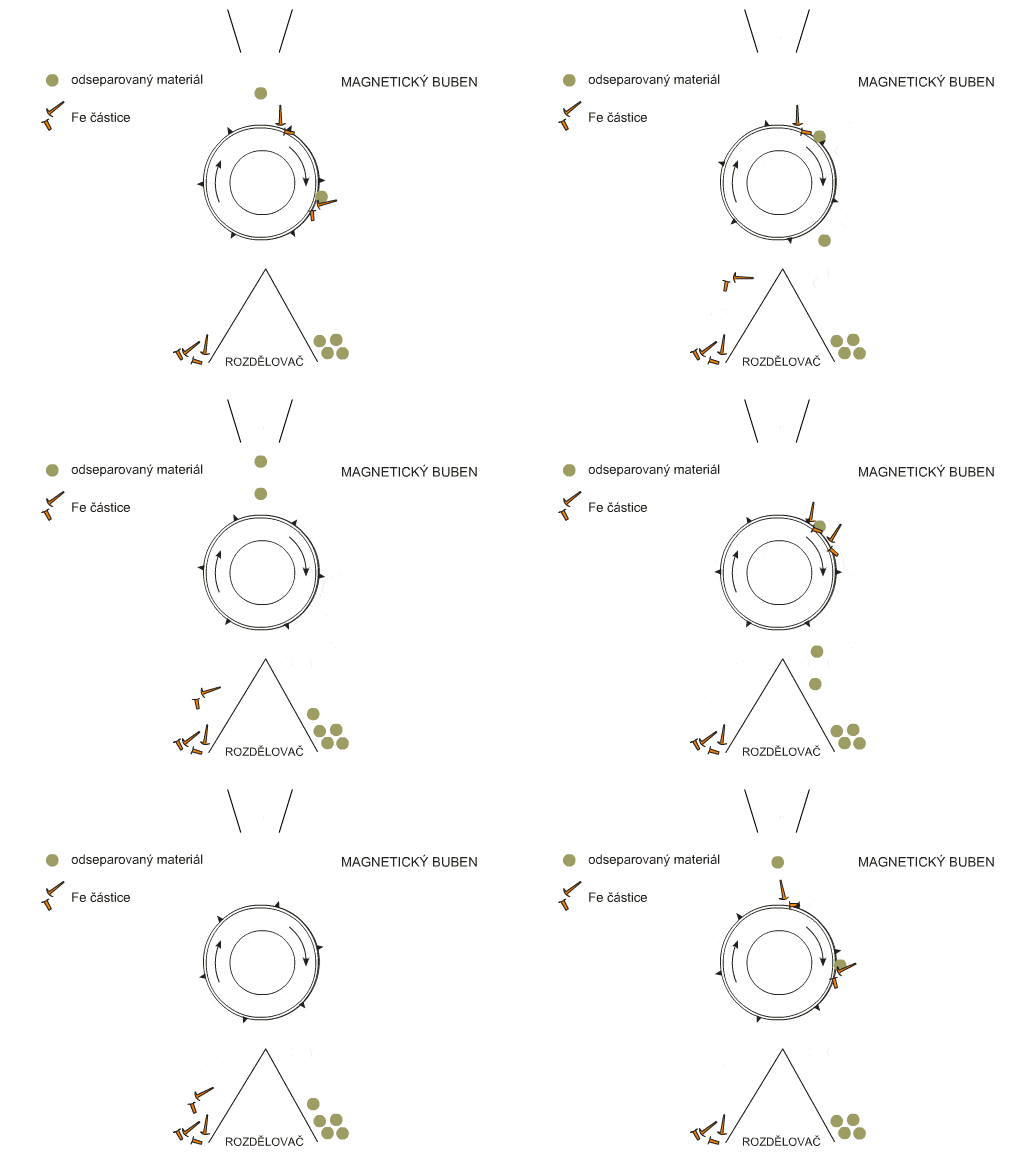

The magnetic drum is made of stainless steel and its dimensions can be adapted to your requirements. Using a magnetic drum significantly improves the quality of the processed material. It is also suitable for applications where downstream equipment must be protected against damage caused by metal particles.
This conveyor breaks up accumulated material and distributes it into an even layer across the entire belt width. The material can then be separated more easily and efficiently, particularly when using a non-ferrous metal separator, magnetic plate, magnetic drum or magnetic roller. The vibratory conveyor is suitable for dry bulk materials. It is not suitable for fine or sticky materials. The high conveyor trough prevents material from spilling outside the conveyor belt.

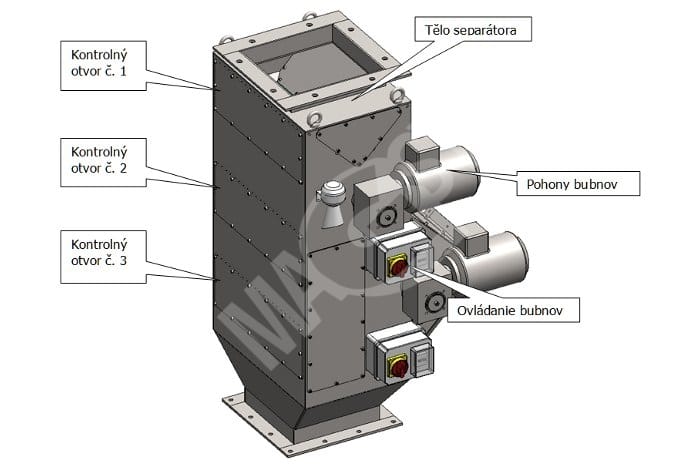
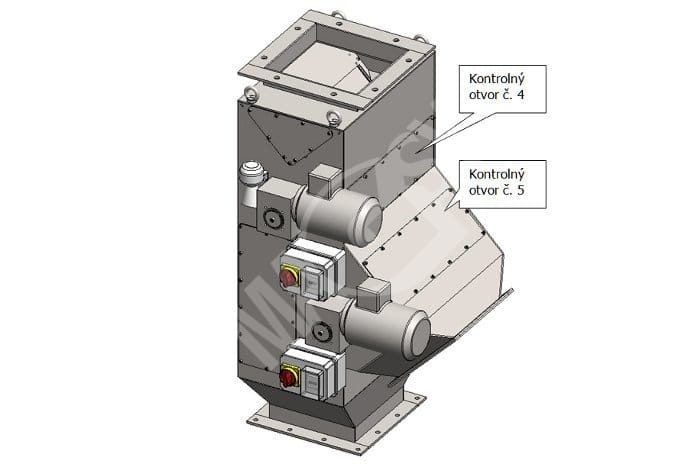
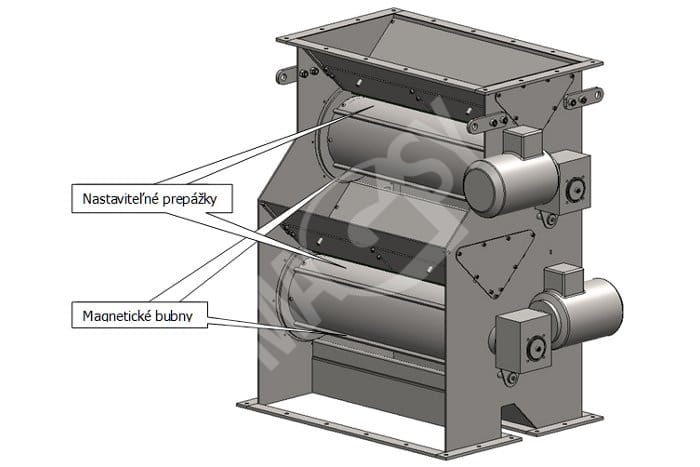
To make installation significantly easier, we also supply the magnetic drum complete with a housing. The separation principle is exactly the same as with the standard magnetic drum. In this version, the magnetic drum is installed inside the housing, eliminating the need to arrange a separate mounting system for the drum.

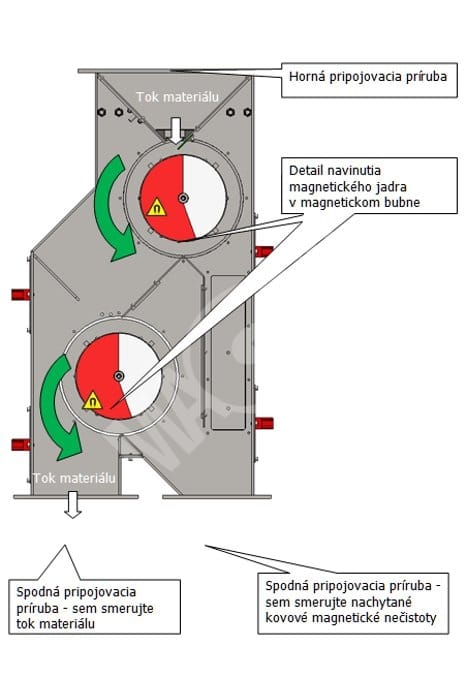
The material to be separated is fed into the housing through the upper opening. The housing has two outlets through which the metals and the separated material are discharged independently. We adapt the drum diameter and length as well as the housing dimensions to your requirements.

We supply the magnetic drum in a housing complete with a motor and gearbox. It can be fitted with either ferrite magnets or significantly stronger NdFeB neodymium magnets.

This double-deck magnetic drum is suitable for operations where an even higher separation quality is required, which is achieved by adding a second magnetic drum. It is also used to minimise contamination of the captured metals by the separated material in applications where the highest possible purity of the separated metals is required.
The magnetic drums of this separator can be fitted with either ferrite magnets or very powerful NdFeB neodymium magnets. They can also be combined, with one magnetic drum fitted with ferrite magnets and the other with neodymium magnets. We recommend consulting us when selecting the appropriate type of magnets and determining the correct drum order when combining both types of magnets. Please contact us with your enquiry. We will be happy to advise you.

You can select the rotational speed of each drum independently. Upon request, we can equip the drum with audible and visual signalling.
As the manufacturer of this equipment, we produce it precisely according to your requirements – we adapt the separator dimensions to your technology, recommend a suitable drum diameter and length, and help you select the most appropriate magnets.
 |
 |
 |
 |
The magnetic drum is suitable for separating metallic magnetic particles from bulk mixtures, such as non-ferrous metals, plastic granulate and other materials falling from a machine hopper or belt conveyor.
When selecting a suitable magnetic drum, it is important to consider the type of material being separated, the required separation quality, the necessary drum dimensions, the appropriate type of magnets, the installation method and any requirements for a housing or double-deck version.
We will adapt the separator dimensions to your technology, recommend a suitable drum diameter and length, and help you select the most appropriate magnets.
Please describe your needs as precisely as possible. We will send you a confirmation of your request and redirect you to a suitable specialist. He or she can contact you for further details at the contacts listed.